Timeless Craftsmanship: Explore the Black Dial Daytona

The Black Dial Daytona: An Icon That Needs No Introduction
There are watches, and then there is the Rolex Daytona with a black dial. It occupies a category almost entirely its own. Since its introduction in 1963, the Daytona has evolved from a purpose-built racing chronograph into one of the most sought-after luxury timepieces in the world. The black dial variant, in particular, carries a certain gravity that collectors and enthusiasts recognize immediately. It is not simply a color preference. It is a statement. This guide walks through everything worth knowing about the black dial Daytona, from its history and technical features to its enduring appeal in both the vintage and contemporary markets.
A Brief History of the Rolex Daytona
Rolex introduced the Cosmograph Daytona in 1963, designed specifically for professional racing drivers. The watch was named after the famous Daytona International Speedway in Florida, and its tachymeter bezel was engineered to measure average speeds up to 400 kilometers per hour. Early models featured manual-winding movements and were available in both black and white dial configurations. The black dial versions from the 1960s and early 1970s, particularly references 6239, 6241, and 6263, are now among the most collectible wristwatches ever produced. Paul Newman famously wore a variant of this model, which sent auction prices into extraordinary territory. In 2017, his personal Daytona sold for over 17 million dollars, setting a world record at the time. That moment crystallized what many already knew: the Daytona, especially in black, is in a league of its own.
What Makes the Black Dial So Special
The appeal of the black dial Daytona goes beyond aesthetics. There is genuine technical and historical reasoning behind why collectors prioritize this configuration. Black dials, particularly on vintage references, were often produced using lacquer or later, matte finishes that respond differently to light than their white counterparts. On the original exotic or tropical dial variants, oxidation over decades can transform black dials into rich, layered surfaces that look almost like dark wood or deep amber. These naturally aged dials are among the most prized in the entire watch collecting world. On modern Daytonas, the black dial continues to command respect because of how cleanly it contrasts against the luminous hour markers, the polished case, and the sub-register counters. It is a design that reads immediately on the wrist and holds its composition across decades of design evolution.
Key References to Know: Vintage to Modern
For anyone navigating the black dial Daytona landscape, understanding the major references is essential. Each generation brought meaningful changes in movement, case design, and dial execution.
Reference 6239 — The first Daytona, introduced in 1963, with a manually wound Valjoux 72 movement and screw-down pushers Reference 6263 — A later manual-wind reference with a more refined bezel and improved water resistance Reference 16520 — The first Daytona with an automatic movement, powered by the Zenith El Primero caliber, produced from 1988 to 2000 Reference 116520 — Rolex introduced an in-house caliber 4130 movement in 2000, setting a new benchmark for the model Reference 126500LN — The current generation, featuring a ceramic bezel, improved power reserve, and updated case proportionsEach reference tells a different chapter of the same story. Whether you are drawn to the raw, vintage character of the 6239 or the refined engineering of the 126500LN, the black dial runs consistently through all of them as a throughline of timeless design.
The Movement Behind the Masterpiece
Precision is not incidental to the Daytona. It is the point. The watch was built to measure time accurately in demanding conditions, and that core purpose has shaped every movement Rolex has used. The early Valjoux-based calibers were reliable workhorses, but the real turning point came in 1988 with the integration of the Zenith El Primero movement, which Rolex modified significantly to meet its own performance standards. That movement ran at a high-beat frequency and offered greater accuracy for the chronograph function. Then, in 2000, Rolex introduced the in-house caliber 4130, developed entirely within their own manufacture. This movement simplified the chronograph mechanism, reduced the number of parts, and improved serviceability and long-term reliability. It remains in use today in updated form, and it is widely regarded as one of the best chronograph movements in production watchmaking.
Black Dial Daytona in Precious Metals and Materials
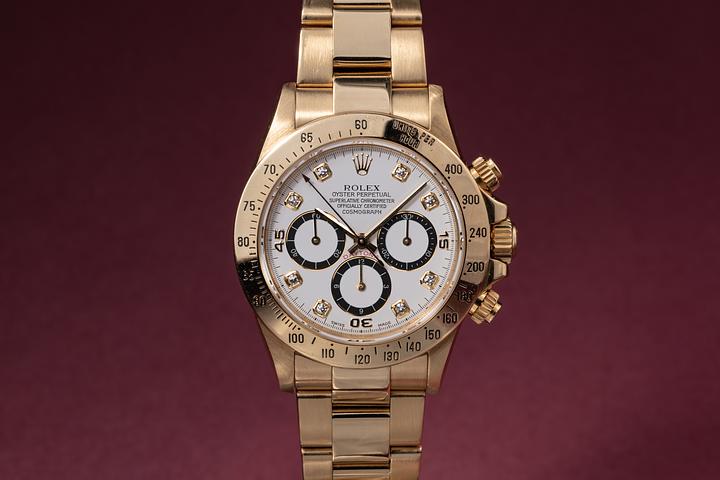
One of the reasons the black dial Daytona translates so well across different configurations is its versatility as a design element. The contrast it provides works in stainless steel, in yellow gold, in white gold, and in Everose gold. Each metal brings a distinct character to the same fundamental design. The stainless steel version with a black dial is arguably the most wearable, offering that perfect balance between sportiness and dressed-up intention. The gold variants carry more formality and visual weight, while the Everose option adds warmth that plays beautifully against the dark dial surface. Rolex also offers black dial configurations with diamond-set bezels and numerals, which shift the watch further into haute horology territory without abandoning the Daytona's functional roots.
Buying a Black Dial Daytona: New vs. Vintage
This is a real decision point, and the right answer depends entirely on what you value. New black dial Daytonas from Rolex authorized dealers come with full warranty coverage, modern movement technology, and the assurance of authentication directly from the source. However, availability at retail has been historically limited, and waitlists are common. The vintage market offers something different altogether. A well-preserved vintage Daytona with a genuine black dial carries history, character, and investment potential that new watches simply cannot replicate. Patina, provenance, and originality are the currency of vintage collecting, and the black dial Daytona delivers on all three when sourced carefully. Working with a trusted, knowledgeable specialist is essential in the vintage space, where condition grading and authenticity verification make a significant difference to value.
Caring for Your Black Dial Daytona
Whether vintage or contemporary, a black dial Daytona deserves attentive care. A few practical guidelines go a long way in preserving both function and appearance.
Service the movement on schedule, typically every five to ten years depending on wear frequency and environmental exposure Avoid prolonged exposure to extreme temperatures or direct sunlight, particularly for vintage dials that may be more sensitive to light oxidation Store the watch in a proper watch box or winder away from humidity and magnetic fields Have any bracelet polishing done conservatively to preserve original finishing, especially on vintage references When purchasing vintage, request a full service history and independent authentication from a qualified watchmakerProper maintenance is not just about protecting an investment. It ensures that the mechanical craftsmanship at the heart of the watch continues to perform as intended, year after year.
Why Tropical Watch Is the Right Partner for Your Daytona Search
Finding the right black dial Daytona requires more than browsing listings. It requires access to genuine expertise, a trusted network, and a team that understands exactly what separates an exceptional example from a merely adequate one. Tropical Watch has built its reputation precisely on that level of discernment. Specializing in vintage and pre-owned Rolex watches, the team brings deep knowledge of dial authenticity, reference history, and market valuation to every piece they offer. If you are serious about acquiring a black dial Rolex Daytona with confidence and clarity, exploring the curated inventory at Tropical Watch, your trusted source for vintage and pre-owned Rolex Daytona watches, is a natural and well-informed starting point. The focus on authenticity, transparency, and collector-grade sourcing makes it a destination that serious enthusiasts return to consistently.
Frequently Asked Questions About the Black Dial Daytona
What is a black dial Daytona?
The black dial Daytona refers to any reference of the Rolex Cosmograph Daytona featuring a black primary dial. This configuration has been offered since the model's introduction in 1963 and remains one of the most desirable dial options across all generations of the watch.
Why are vintage black dial Daytonas so valuable?
Vintage black dial Daytonas are valuable because of their rarity, historical significance, and the natural aging characteristics of original dials. Models associated with specific references or notable provenance, such as those connected to Paul Newman, command exceptional prices at auction and in private sales.
What is a tropical dial on a Daytona?
A tropical dial refers to a Daytona dial that has changed color over decades due to chemical or environmental exposure. Originally black dials may shift to warm brown, chocolate, or amber tones. These naturally transformed dials are considered highly desirable by collectors for their unique appearance and rarity.
Is the black dial Daytona a good investment?
The black dial Daytona has historically performed well as a collectible asset, particularly in vintage references. While no watch purchase should be treated purely as a financial investment, the Daytona's sustained demand, limited supply, and strong auction history support its reputation as one of the most resilient luxury watch values in the market.
How do I authenticate a vintage black dial Daytona?
Authentication of a vintage black dial Daytona involves examining the dial printing, case serial and reference numbers, movement caliber, and overall condition against documented examples. Working with a reputable specialist dealer or independent watchmaker with specific Rolex expertise is strongly recommended before any purchase.
What is the difference between the Daytona references 116520 and 126500LN?
The 116520 was produced from 2000 to 2016 and features an in-house caliber 4130 movement with an aluminum bezel. The 126500LN, introduced in 2023, uses an updated caliber 4131 movement, introduces a ceramic bezel, and includes refinements to the case and bracelet construction. Both are available with black dials and are highly regarded in the collector community.