Rolex Watch Service Guide: When, Why, and What to Expect
Why Rolex Watch Servicing Is Not Optional — It Is Essential
There is a certain kind of watch owner who never thinks about servicing their Rolex — until something goes wrong. And then there is the kind who understands that a mechanical timepiece is not simply a possession but a system in motion, one that demands periodic attention to stay accurate and alive. The truth is that a Rolex, no matter how legendary its engineering, contains hundreds of moving components that rely on lubrication, calibration, and careful inspection to function properly over the long term. Skipping service does not just risk performance — it risks permanent damage. Understanding when to service, what happens during the process, and why it genuinely matters is the kind of knowledge that separates casual ownership from true stewardship.
How Often Should a Rolex Be Serviced
Rolex officially recommends that their timepieces be serviced approximately every ten years, though this figure comes with important context. Older models, particularly those manufactured before the 1990s, may require attention more frequently — closer to every five to seven years — simply because their movements and sealing technology were built to earlier standards. A watch worn daily in active conditions, exposed to water, dust, or temperature extremes, may also need servicing sooner than one kept primarily in a watch box. The ten-year recommendation applies to modern Rolex watches under normal wearing conditions, and it is a guideline, not a hard cutoff. Paying attention to subtle signs — slight timekeeping deviation, a crown that feels stiff, or condensation beneath the crystal — tells you far more about your specific watch's needs than any calendar ever will.
The Warning Signs That Your Rolex Needs Attention Now
A Rolex is built to perform quietly and without drama, which is exactly what makes it difficult to know when something is off. That said, a few indicators should never be ignored. Accuracy is the first thing to watch. A Rolex in good working order typically runs within plus or minus two seconds per day. If your timepiece is losing or gaining significantly more than that on a consistent basis, the movement may be running dry or experiencing wear. A crown that resists normal winding or setting suggests the gaskets may have hardened and lost their seal. Visible moisture or fogging inside the crystal is a serious warning that water has entered the case — this requires immediate attention to prevent corrosion of the movement. Any grinding, stuttering, or irregular feel during winding is another clear signal. None of these signs should be treated as minor inconveniences.
What Actually Happens During a Rolex Service
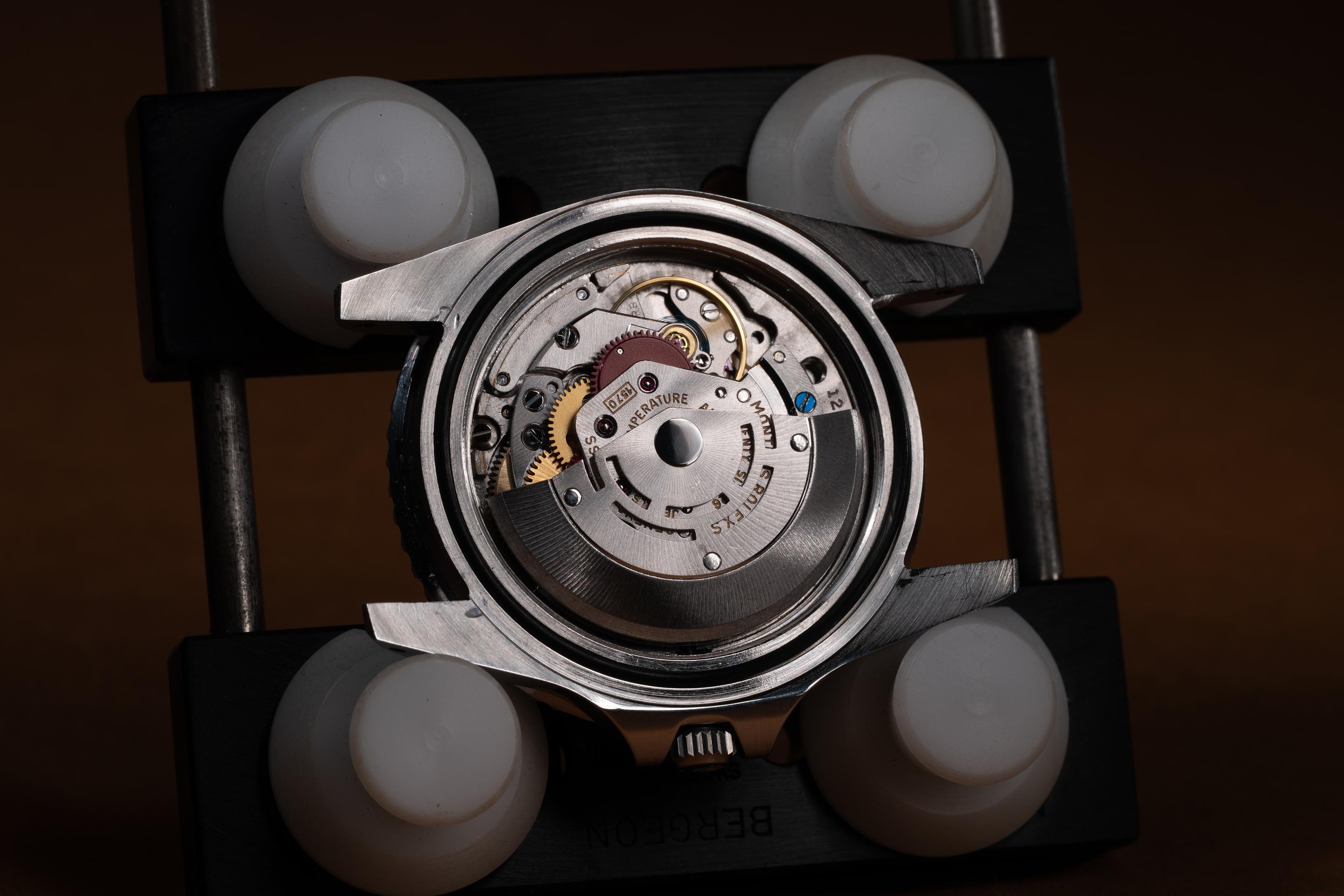
This is the part most watch owners are genuinely curious about, and rightfully so. A proper Rolex service is a thorough and technically demanding process. It begins with complete disassembly — the movement is removed from the case, the dial and hands are carefully detached, and every individual component of the caliber is separated. Technicians then examine each part under magnification, identifying wear, damage, or components that need replacement. The entire movement is cleaned ultrasonically and by hand, removing years of oxidized lubricant and particulate matter. Once cleaned, each part is inspected again, worn components are replaced with genuine parts, and the movement is reassembled with fresh oils applied at precise points throughout the gear train, escapement, and rotor assembly. The case and bracelet undergo their own process — gaskets are replaced, the case is pressure-tested for water resistance, and surfaces are refinished if requested. The watch is then tested for accuracy across multiple positions before being returned to the owner.
Rolex Service at an Authorized Center Versus Independent Watchmakers
The service question often leads to another: where should your Rolex actually be serviced? Rolex Authorized Service Centers operate under strict brand standards and use genuine Rolex parts. For watches still under the manufacturer's five-year warranty, servicing at an authorized center is typically required to maintain coverage. Independent watchmakers with specific Rolex experience and access to quality parts are a legitimate option for many owners, particularly those with vintage models. Rolex no longer manufactures parts for every historical caliber, and experienced independent specialists often have the expertise and component access that makes them uniquely suited for older references. The critical factor in either case is expertise. A Rolex movement is not a standard repair job, and it should never be treated as one.
The Real Cost of Skipping a Rolex Service
Rolex service is an investment, and it can feel like a significant one — depending on the model and service center, costs can range from several hundred to well over a thousand dollars. But consider what deferred maintenance actually costs in the long run. When a movement runs without fresh lubrication, metal-on-metal contact accelerates wear on pivots, jewels, and gear teeth. Hardened gaskets allow moisture infiltration. A single instance of water damage to a movement can result in corrosion that requires far more extensive and expensive restoration work than a routine service would have cost. For vintage Rolex watches especially, proper care directly affects both the function and the long-term value of the piece. Neglect is not cost-saving. It is cost-deferring, and usually with interest.
Rolex Service and Its Impact on Watch Value
There is a common misunderstanding in watch collecting circles about whether servicing affects value. The reality is nuanced. A well-documented service history — especially one performed by reputable specialists using appropriate parts — generally supports value, particularly for vintage references where condition and functionality matter deeply to buyers. What can affect value negatively is improper servicing: incorrect lubricants, non-original replacement parts, or overly aggressive case polishing that removes original finishing. Keeping records of every service, including who performed it and what was replaced, is a practice that pays dividends if you ever choose to sell or insure your Rolex. Provenance matters in luxury watches, and service documentation is part of that story.
Special Considerations for Vintage Rolex Watches
Vintage Rolex watches require a level of care and technical knowledge that goes beyond what modern references demand. Movements from the 1950s, 1960s, and 1970s often contain components that are no longer in production, meaning a technician must source period-correct parts, fabricate replacements when necessary, or make careful judgment calls about what can be preserved versus replaced. Over-polishing a vintage case destroys the sharp angles and patina that define its character and value. A dial with honest age and original lacquer is worth more intact than replaced with a reproduction. Servicing a vintage Rolex is genuinely a different discipline, and it deserves a specialist who understands both the mechanical and historical dimensions of the piece they are working on.
Why Tropical Watch Is the Right Partner for Rolex Collectors
For collectors who take their Rolex ownership seriously — whether they are managing a single treasured piece or building a focused collection — having the right partner matters enormously. Tropical Watch has built its reputation on a deep, genuine understanding of the vintage Rolex market, with an inventory and expertise that reflects years of immersion in the space. If you are searching for authenticated vintage Rolex watches with documented service history, Tropical Watch approaches every piece with the kind of scrutiny and transparency that serious collectors expect. Each watch is evaluated not just as a transaction but as a horological artifact with its own history and integrity. For anyone serious about vintage Rolex — as a purchase, a collection piece, or an informed investment — Tropical Watch is a name worth knowing.
Frequently Asked Questions About Rolex Watch Servicing
How often does a Rolex need to be serviced?
Rolex recommends servicing modern watches approximately every ten years under normal wearing conditions. Vintage models or watches used in demanding environments may require service every five to seven years. The best indicator is the watch's actual performance, not a fixed schedule alone.
What does a Rolex service include?
A full Rolex service includes complete disassembly of the movement, ultrasonic and manual cleaning of all components, inspection and replacement of worn parts, fresh lubrication, reassembly, case and bracelet servicing, gasket replacement, water resistance pressure testing, and multi-position accuracy testing before the watch is returned.
How much does it cost to service a Rolex?
Service costs vary based on the model, the extent of work required, and whether service is performed at an Authorized Service Center or by an independent specialist. Costs typically range from several hundred dollars to over one thousand dollars for complex references or those requiring significant parts replacement.
Can I service my Rolex at an independent watchmaker?
Yes, and for vintage Rolex watches in particular, experienced independent watchmakers with Rolex-specific knowledge are often the preferred choice. The key is confirming the technician's expertise, their access to appropriate parts, and their understanding of how to preserve original components and finishing.
Does servicing a Rolex affect its value?
Proper servicing with documented records generally supports long-term value, especially for vintage references. Improper servicing — including aggressive polishing, incorrect lubricants, or non-original parts — can negatively impact both condition and resale value. Keeping service records is strongly recommended.
What are the signs that a Rolex needs servicing immediately?
Significant timekeeping inaccuracy beyond normal tolerances, a stiff or unusual crown feel, visible moisture or fogging inside the crystal, irregular sounds during winding, or a rotor that does not spin freely are all signs that a Rolex requires prompt professional attention rather than a wait-and-see approach.