Rolex GMT-Master II Watch History, Craftsmanship and Legacy
The Rolex GMT-Master II: A Watch Built for the World
There are tool watches, and then there is the Rolex GMT-Master II. Since its introduction in 1983, this timepiece has occupied a singular position in the luxury watch world — respected by pilots, engineers, collectors, and anyone who takes precision seriously. It was not designed to be flashy, though it certainly became iconic. It was designed to solve a real problem: tracking multiple time zones at once. That purpose-driven origin is exactly what makes it one of the most compelling watches ever produced. Whether you are new to luxury watches or deep into a collection, the GMT-Master II deserves a serious look.
The Origins: Pan Am, Pilots, and a Problem Worth Solving
The story actually starts a few years before the GMT-Master II. In 1955, Rolex debuted the original GMT-Master in collaboration with Pan American World Airways. Pilots flying transatlantic routes needed a reliable way to read two time zones simultaneously — their home time and the time at their destination. Rolex delivered with a 24-hour bezel and a fourth hand that could be set independently. It was a working tool, not a status symbol, though it quickly became both. The GMT-Master II arrived in 1983, refining the concept significantly. The key upgrade was the ability to set the local hour hand independently of the GMT hand, without stopping the movement. That sounds like a small change until you realize it meant the watch could be adjusted mid-flight without losing accuracy. For travelers and professionals, that distinction mattered enormously.
What Makes the GMT-Master II Different From Other Watches
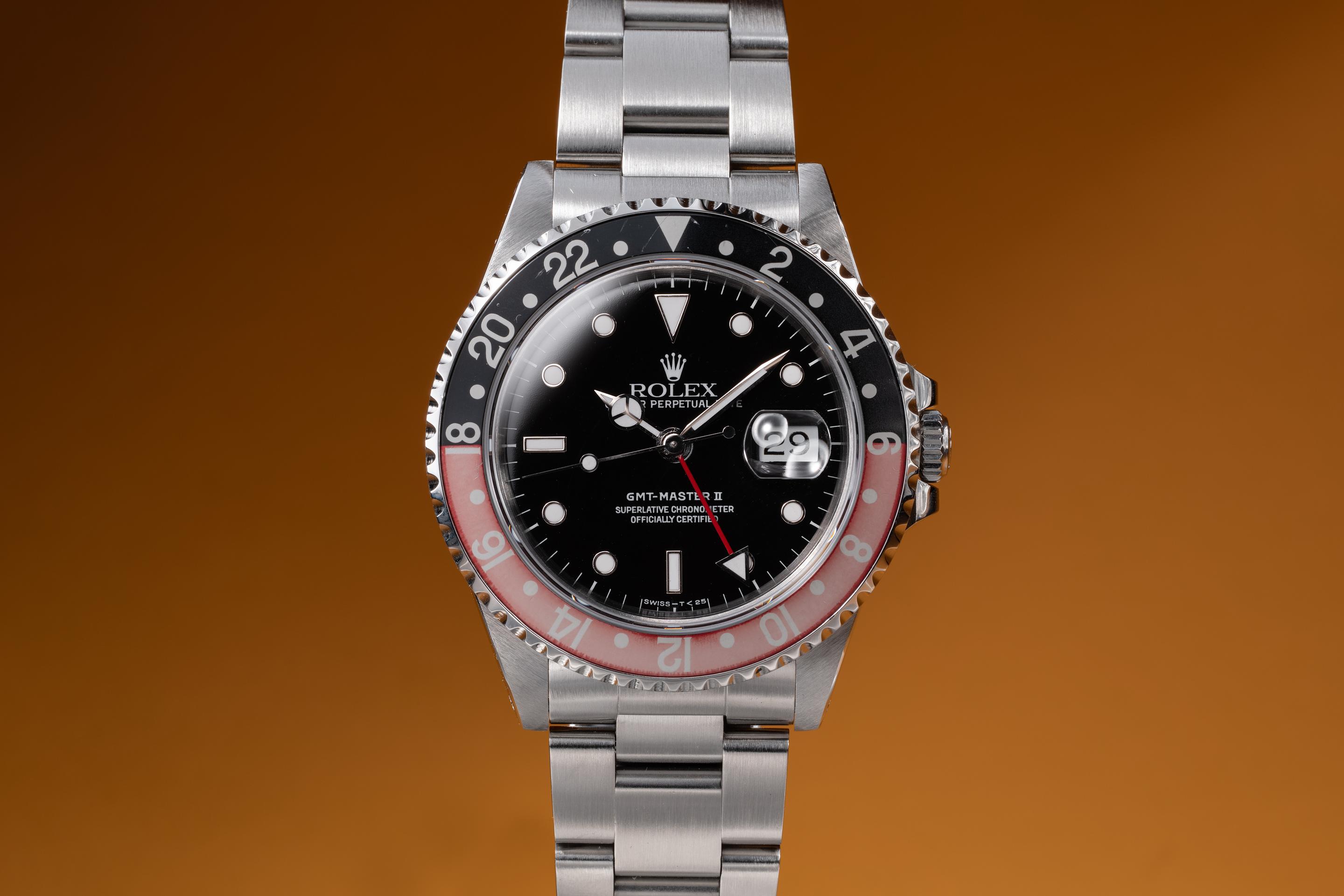
Let us be specific about what sets this reference apart. Most watches tell one time. The GMT-Master II tells three — simultaneously. The hour and minute hands display local time, the 24-hour hand tracks a second time zone against the bezel, and the bezel itself can be used to read a third zone. For a watch that fits on your wrist, that is genuinely impressive functionality. The movement powering modern references is the Calibre 3285, an in-house Rolex movement featuring the Chronergy escapement, which improves energy efficiency, and a power reserve of approximately 70 hours. The case is constructed from Oystersteel, Rolex's proprietary 904L stainless steel alloy, which is more corrosion-resistant than the industry-standard 316L steel. Waterproofing runs to 100 meters. Every element has been thought through.
Iconic Bezel Combinations and What They Mean
Part of what makes collecting the GMT-Master II genuinely fascinating is the bezel history. Over the decades, Rolex has produced bezel and dial combinations that have taken on their own names and identities within the watch community. A few of the most recognized configurations include:
Black and red bezel — known as the "Pepsi," referencing the soft drink brand's color palette All-black bezel — often called the "Darth Vader" among collectors Black and blue bezel — referred to as the "Batman" Blue and black bezel — the newer "Bruce Wayne" variant All-red bezel — associated with early references and now highly sought afterThese names were not invented by Rolex — they emerged organically from enthusiasts who needed shorthand for identification. Rolex leaned into some of them over time, recognizing that the collector community had given these references lives of their own. The Pepsi bezel, for example, first appeared in the late 1950s on the GMT-Master and has experienced several reinventions across decades, each generation adding nuance to the design. The ceramic Cerachrom bezels introduced in more recent years resist fading and scratching far better than the older aluminum inserts, though many collectors still value the original aluminum versions for their patina and authenticity.
Key Reference Numbers and Their Historical Significance
Understanding the GMT-Master II means getting familiar with the reference numbers that define its generations. Each reference tells a story about when it was made and what innovations it carried.
Reference 16760 — the first GMT-Master II, introduced in 1983, featuring an independently adjustable hour hand Reference 16710 — produced from 1989 to 2007, more refined case and movement Reference 116710LN — introduced in 2007 with the Cerachrom black bezel and updated Calibre 3186 Reference 116710BLNR — the "Batman," introduced in 2013 with a blue and black ceramic bezel Reference 126710BLRO — the modern Pepsi reference, reintroduced in 2018 on a Jubilee braceletEach of these references carries different collecting characteristics. Early references with original dials, unpolished cases, and matching bracelets command significant premiums in the vintage market. A reference 16760 in exceptional condition, for instance, represents a meaningful piece of horological history — the watch that introduced the complication that defined the line going forward.
Craftsmanship: The Rolex Standard Up Close
Rolex manufactures nearly every component of its watches in-house, which is not common in the watch industry. The GMT-Master II's movement is assembled by hand, tested rigorously, and certified as a chronometer by the Controle Officiel Suisse des Chronometres, meaning it must maintain accuracy within minus four and plus six seconds per day. The Oyster case and bracelet are finished with a combination of brushed and polished surfaces, a process requiring considerable skill to execute cleanly at scale. The crown-protecting Triplock winding crown, the reinforced clasp, the magnified date window — these are not afterthoughts. They are engineering decisions that accumulate into a product that feels coherent and considered. The longevity of these watches in active use, across demanding conditions, speaks to that manufacturing ethos.
The GMT-Master II as a Collectible Asset
Beyond functionality, the GMT-Master II has proven itself a serious collectible. Vintage references have appreciated considerably over time, with rare dial configurations, original-condition components, and documented provenance all influencing value. The luxury watch market has matured significantly, with serious auction houses and specialist dealers treating vintage Rolex references with the same scholarly attention once reserved for art and rare coins. The condition of the original bracelet, the presence of original papers and box, and the state of the dial lume all factor into valuation. Even relatively common references in exceptional, unrestored condition can trade well above retail. For collectors, the GMT-Master II sits in an interesting position — functional enough to wear daily, rare enough in certain configurations to hold and grow in value.
Buying a GMT-Master II: New, Pre-Owned, or Vintage
New GMT-Master II watches are produced in current references with ceramic bezels, updated movements, and modern bracelet finishing. They carry manufacturer warranties and are available through authorized dealers, though waitlists for popular references remain lengthy. Pre-owned examples offer access to references that may no longer be in production, often at different price points depending on condition. Vintage references — broadly considered to be those produced before the mid-1990s — require more careful evaluation. Authenticating vintage Rolex watches involves examining case serial numbers, movement references, dial printing, and bracelet codes. Working with a reputable, knowledgeable dealer or specialist is strongly recommended for any vintage purchase of significance.
Why Tropical Watch Is the Right Partner for Your GMT-Master II Journey
Finding the right source for a vintage or pre-owned Rolex GMT-Master II matters as much as finding the right reference. Tropical Watch has built its reputation around exactly this niche — a deep, curated inventory of verified vintage and luxury timepieces, with the expertise to back every acquisition. If you are serious about adding a GMT-Master II to your collection, exploring the vintage Rolex GMT-Master II watches available at Tropical Watch puts you in front of carefully sourced, expertly evaluated examples that meet a genuine standard of quality. The team at Tropical Watch brings the kind of focused knowledge that transforms a purchase into a confident investment, not a gamble. For collectors at any stage — whether acquiring a first serious piece or adding a specific reference to an existing collection — that level of expertise is not incidental. It is essential.
Frequently Asked Questions About the Rolex GMT-Master II
What is the difference between the GMT-Master and the GMT-Master II?
The original GMT-Master, introduced in 1955, featured a 24-hour bezel and a dedicated GMT hand but did not allow the local hour hand to be set independently. The GMT-Master II, introduced in 1983, added the ability to adjust the local hour hand separately without stopping the movement, making it significantly more practical for travelers crossing multiple time zones.
What do the Pepsi, Batman, and Sprite bezels mean on the GMT-Master II?
These are collector nicknames based on the color combinations of the two-tone bezels. Pepsi refers to the red and blue bezel, Batman to the black and blue, and Sprite or Bruce Wayne to certain green and black configurations. Rolex did not officially assign these names, but they are widely recognized within the watch community and help enthusiasts quickly identify specific references.
Is the Rolex GMT-Master II a good investment?
Historically, the GMT-Master II has demonstrated strong value retention, particularly in rare references, exceptional original condition, and vintage examples with complete documentation. However, like any collectible market, values fluctuate. Purchasing from a reputable specialist and focusing on condition and provenance are the most reliable strategies for preserving value over time.
How do I read three time zones on the GMT-Master II?
The standard hour and minute hands display local time. The 24-hour GMT hand, which completes one rotation in 24 hours, points to a second time zone on the 24-hour bezel. By rotating the bezel, a third time zone can be read using the same GMT hand against the bezel markers. With practice, reading all three simultaneously becomes intuitive.
What should I look for when buying a vintage Rolex GMT-Master II?
Key factors include the originality of the dial, case sharpness and whether the case has been polished, bracelet condition and stretch, movement authenticity, and matching reference numbers across components. Documentation such as original papers, warranty cards, and box significantly increases a vintage watch's collectibility and value. Working with a specialist who can authenticate these details is highly advisable.
How accurate is the Rolex GMT-Master II movement?
Modern GMT-Master II references use the Calibre 3285, which is certified as a Swiss chronometer and must maintain accuracy within minus four to plus six seconds per day under standard testing conditions. In practice, many examples perform even more accurately. Rolex also holds watches to its own internal standard, which is tighter than the official chronometer certification requires.