Rolex GMT-Master II: Precision Craftsmanship Across Time Zones
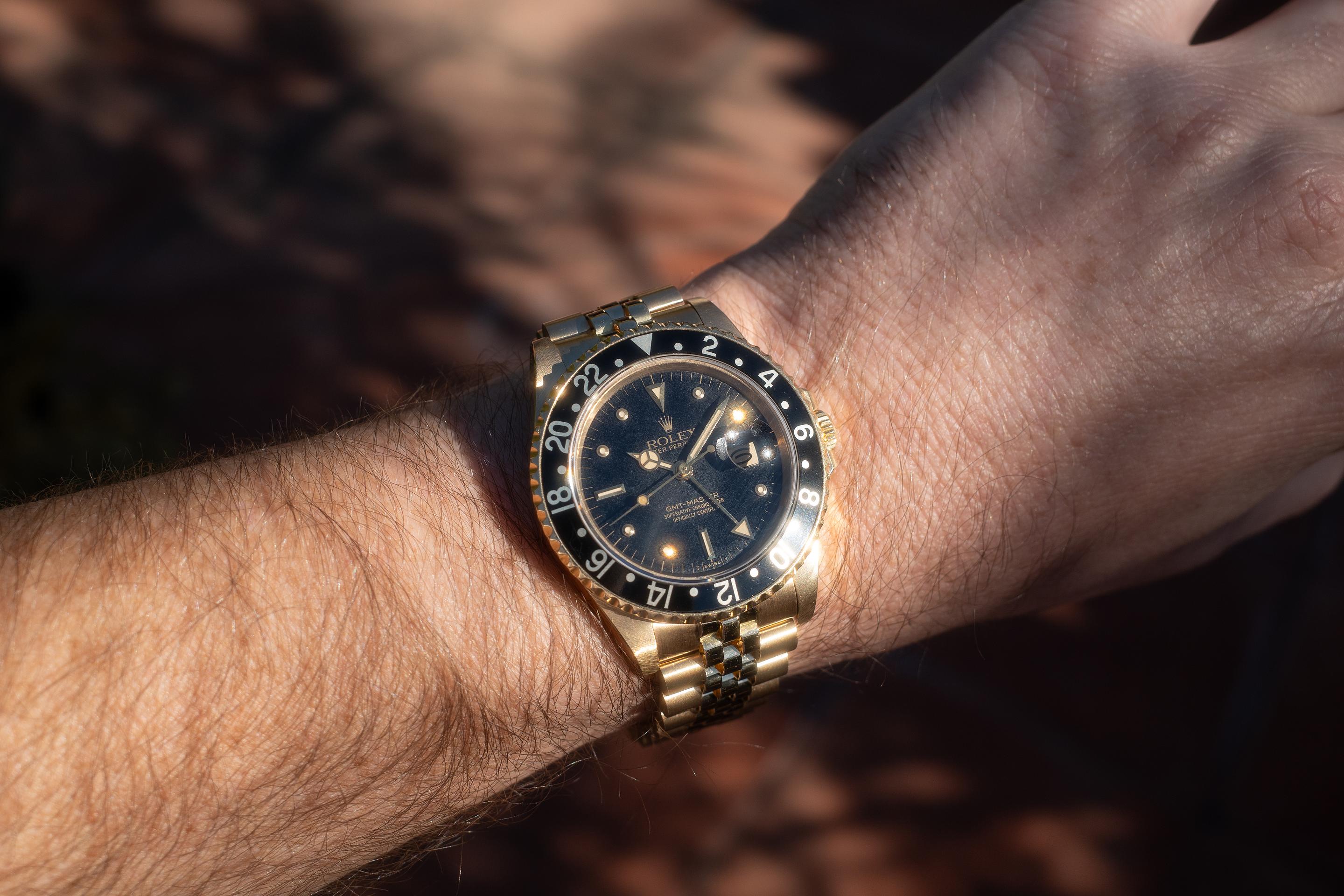
The Rolex GMT-Master II: A Watch Built for the World
There are tool watches, and then there is the Rolex GMT-Master II. Few timepieces have earned a reputation quite like this one — part precision instrument, part design icon, and entirely its own category. Originally developed in partnership with Pan American World Airways in the 1950s, the GMT-Master was created to solve a very real problem: pilots and crew needed to track multiple time zones simultaneously, hands-free, without sacrificing accuracy. Decades later, that same engineering DNA lives inside the GMT-Master II, refined and elevated for a new generation of global travelers, collectors, and enthusiasts who understand that a truly great watch does more than tell time.
A Brief History: From Cockpits to Collectors
The original GMT-Master debuted in 1955, equipped with a two-tone bezel and a dedicated fourth hand that pointed to a 24-hour scale. It was functional, precise, and immediately recognizable. The GMT-Master II arrived in 1983, introducing an independently adjustable hour hand — a meaningful upgrade that allowed wearers to set local time without disrupting the GMT hand or the running seconds. This distinction matters more than people realize. With the GMT-Master II, a traveler could land in Tokyo, adjust the local hour hand with the crown, and still have their home time reference fully intact. That is not a small engineering feat. That is Rolex solving a real problem with quiet confidence, and doing it in a way that looks effortless on the wrist.
Understanding the GMT Function: How It Actually Works
Let us break this down in plain terms because it is worth understanding. The GMT-Master II uses three time references simultaneously. The standard hour and minute hands show local time. A fourth hand, typically arrow-tipped and often a contrasting color, completes one full rotation every 24 hours and points to a fixed 24-hour scale on the bezel. This is your reference time — home base, essentially. The bidirectional rotatable bezel, marked in 24-hour increments, allows the wearer to track a third time zone by rotating the bezel to align with the GMT hand. So in practice, you have home time, local time, and one additional reference — all readable at a glance without pressing a single button. For frequent travelers, this is not a gimmick. It is genuinely useful.
Iconic Bezel Combinations and What They Mean
Part of what makes the GMT-Master II so immediately recognizable is its bezel. Rolex has produced several distinct colorways over the decades, each with its own nickname and devoted following among collectors.
Pepsi — the classic red and blue bezel, originally in aluminum, now available in Cerachrom ceramic Batman — the all-black and blue ceramic bezel introduced in 2013, discontinued and now highly sought after Sprite — green and black ceramic, introduced in 2021 on the Oystersteel and yellow gold model Root Beer — brown and black in the two-tone gold configuration, a warm and understated alternative Coke — red and black, famously associated with vintage references and early production modelsThese nicknames were not invented by Rolex — they came from the collector community, and Rolex leaned into the culture rather than away from it. That relationship between the brand and its audience says something about how deeply embedded this watch has become in horological history.
Movement and Technical Specifications
Inside the GMT-Master II sits the Rolex Calibre 3285, an in-house movement introduced in 2018 and representing one of the more meaningful incremental upgrades in the watch's recent history. The Calibre 3285 operates at 28,800 vibrations per hour and offers a power reserve of approximately 70 hours — a significant improvement over its predecessor. It features the Chronergy escapement, a patented Rolex innovation that improves energy efficiency by roughly 15 percent compared to a traditional lever escapement. The movement is certified as a Superlative Chronometer, meaning it meets Rolex's own strict accuracy standards of plus or minus two seconds per day — a benchmark that exceeds COSC certification. The case is 40mm in diameter, water resistant to 100 meters, and houses a scratch-resistant sapphire crystal. The Oysterlock clasp and Glidelock extension system allow for easy size adjustment without tools, which is a practical detail that frequent travelers actually appreciate.
Materials and Reference Numbers: Knowing What You Are Looking At
The GMT-Master II is offered across several material configurations, and understanding the differences helps when evaluating both new and vintage examples. Oystersteel — Rolex's proprietary 904L stainless steel — is the foundation of the entry-level references. It is notably more corrosion-resistant than the 316L steel used by most competitors. From there, Rolex offers two-tone configurations combining Oystersteel with 18-karat Rolesor gold, and fully precious metal versions in yellow, white, or Everose gold. Reference numbers carry meaningful information. The current Oystersteel Pepsi, for example, carries reference 126710BLRO. The Batman in steel is reference 126710BLNR. Vintage references from the 1980s and 1990s — such as the 16760, sometimes called the Fat Lady due to its slightly wider case — have become particularly collectible. Knowing these distinctions matters when buying, selling, or simply holding a conversation in a room full of watch people.
GMT-Master II on the Secondary Market: What to Know Before You Buy
The GMT-Master II holds value exceptionally well. Certain references, particularly discontinued bezel combinations and vintage examples in unpolished condition with original dials, consistently command significant premiums. The Batman reference 116710BLNR, discontinued in 2019 when the updated 126710BLNR was introduced, remains one of the most traded references on the pre-owned market. When evaluating any used GMT-Master II, condition is paramount. An unpolished case preserving the original brushed and polished surfaces is generally preferred by serious collectors. Original service papers, box, and warranty card — collectively referred to as full set — will meaningfully affect price. Dial originality is equally important. Refinished or repainted dials significantly reduce collector value, even when visually indistinguishable to an untrained eye.
Who Is the GMT-Master II Actually For?
The honest answer is that the GMT-Master II serves a remarkably wide audience, which is part of why it has remained relevant for nearly seven decades. Frequent business travelers genuinely use the GMT function. Watch collectors prize it for its history, mechanical sophistication, and the cultural weight it carries. New enthusiasts are drawn to its recognizability and the fact that it wears well across contexts — equally at home on a trading floor, a hiking trail, or a dinner table. It is not a dress watch, but it is not strictly a sport watch either. It occupies that rare middle ground where function and form coexist without compromise. For a first luxury watch, it is a strong and defensible choice. For a seasoned collector, it represents a cornerstone reference that any serious collection can justify.
Why Tropical Watch Is the Right Place to Find Your GMT-Master II
When it comes to acquiring a Rolex GMT-Master II — whether a current production model or a vintage reference with decades of history — the source matters as much as the watch itself. Tropical Watch has built its reputation on exactly the kind of expertise and integrity that serious collectors and first-time buyers alike deserve. As a trusted destination for authenticated vintage and pre-owned luxury timepieces, Tropical Watch offers access to rare and desirable references that simply do not surface through standard retail channels. If you are searching for a vintage Rolex GMT-Master II for sale from a trusted luxury watch dealer, Tropical Watch brings the knowledge, provenance standards, and curated inventory that make the difference between a good purchase and a great one. Every timepiece is evaluated with the kind of attention to detail that the GMT-Master II demands and deserves.
Frequently Asked Questions About the Rolex GMT-Master II
What is the difference between the GMT-Master and the GMT-Master II?
The original GMT-Master featured a bezel-based 24-hour scale but did not allow independent adjustment of the local hour hand. The GMT-Master II, introduced in 1983, added a quickset mechanism that allows the local hour hand to be set independently without stopping the watch or disrupting the GMT hand, making it far more practical for travelers.
How do you read the time zones on a GMT-Master II?
The standard hour and minute hands show local time. The 24-hour arrow hand tracks a second time zone against the fixed 24-hour scale on the dial. By rotating the bezel, a third time zone can be referenced using that same arrow hand against the bezel's 24-hour markings.
Is the Rolex GMT-Master II a good investment?
Historically, the GMT-Master II has retained and often appreciated in value, particularly for discontinued references and vintage models in unpolished condition with original documentation. While no watch purchase should be made solely as a financial investment, the GMT-Master II has a strong track record on the secondary market.
What does Superlative Chronometer mean on a Rolex?
Superlative Chronometer is Rolex's proprietary certification indicating that a movement has passed internal accuracy testing to a standard of plus or minus two seconds per day after casing. This exceeds the COSC standard and is tested on the complete watch rather than the movement alone.
Which GMT-Master II reference is the most collectible?
Collectibility varies by era and preference, but vintage references such as the 1675, 16750, and 16760 are highly regarded. Among modern references, the discontinued Batman 116710BLNR and early Pepsi references in aluminum bezels are particularly sought after by collectors.
Can the GMT-Master II be worn as an everyday watch?
Yes. The GMT-Master II is built on Rolex's Oyster case, offering 100 meters of water resistance and robust construction designed for daily wear. Its versatile aesthetic allows it to transition between professional and casual environments without difficulty, making it one of the more practical luxury watches available.