Bruce Wayne GMT-Master 1675: The Collector's Guide
The Bruce Wayne GMT Rolex: What It Is and Why It Matters
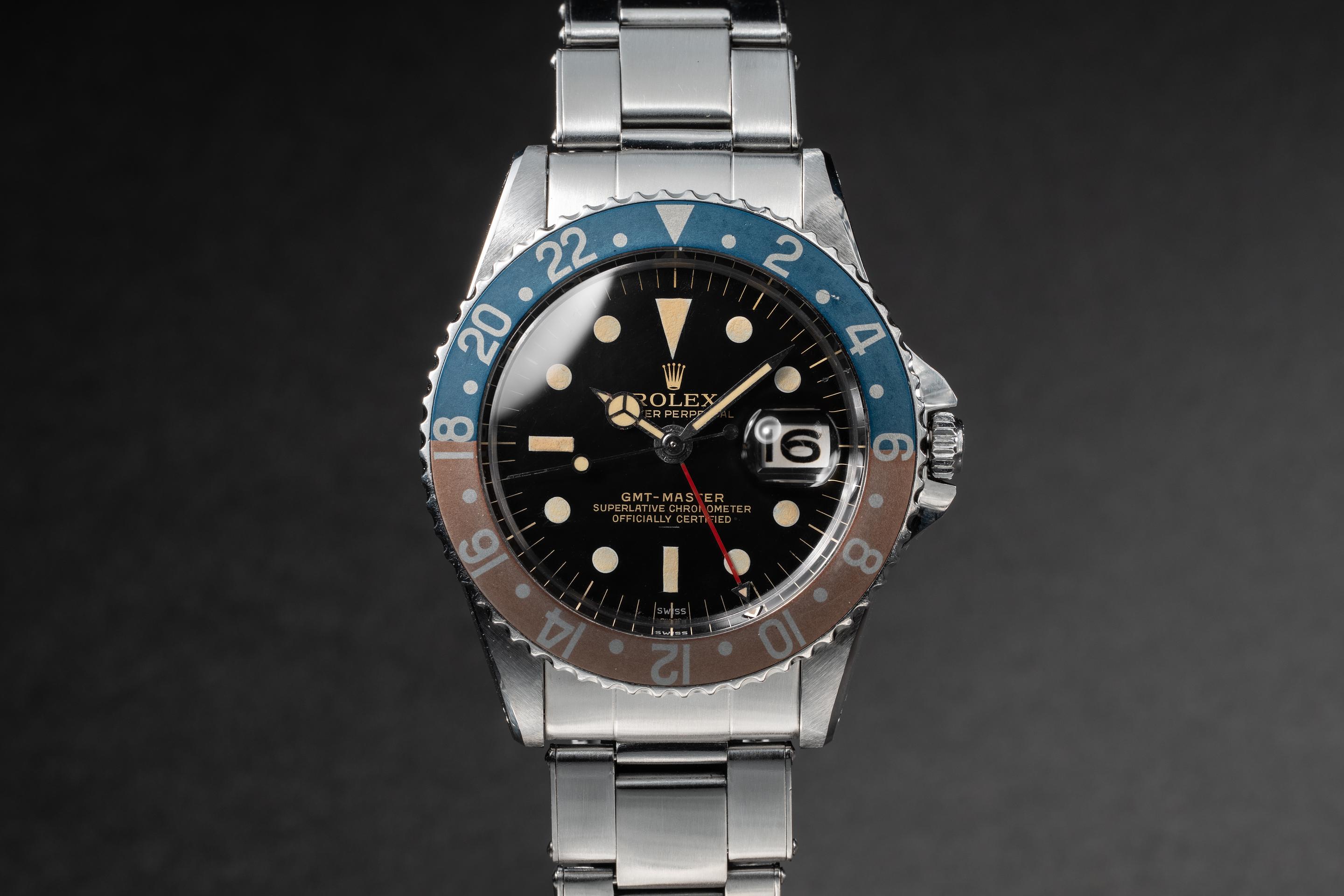
If you have spent any time around vintage Rolex collecting, you have almost certainly heard the name "Bruce Wayne" attached to a specific GMT-Master reference. It sounds like something out of a film, and honestly, the nickname fits. The Bruce Wayne GMT refers to the Rolex GMT-Master reference 1675, produced during the late 1960s through the 1970s, distinguished by a matte black dial and a specific combination of case and bracelet details that collectors have come to associate with a kind of effortless, dark sophistication. The nickname itself is collector slang, not an official Rolex designation, but in the vintage watch world, names like this carry real weight. They describe something real, something distinguishable, and in this case, something genuinely desirable.
Understanding the Rolex GMT-Master Reference 1675
Before getting into the specifics of the Bruce Wayne configuration, it helps to understand the GMT-Master reference 1675 as a whole. Rolex introduced this reference in 1959 as a successor to the original GMT-Master reference 6542. The 1675 was built for professional use, specifically designed in collaboration with Pan American World Airways to allow pilots and crew to track two time zones simultaneously. The additional 24-hour bezel hand and rotatable bezel made that possible at a glance. Rolex produced the 1675 for roughly two decades, from 1959 to around 1980, and across that production window there were numerous variations in dial text, case finishing, bezel insert colors, and bracelet configurations. That long production run is part of why so many distinct collector subcategories have emerged within this single reference number.
What Exactly Makes a GMT-Master a Bruce Wayne
The Bruce Wayne nickname is specifically applied to examples of the reference 1675 that feature a matte black dial paired with a black and red bezel insert, which collectors often call the Pepsi bezel in its red and blue form, though the all-black or black and red variants carry their own distinct identity. More precisely, what defines the Bruce Wayne configuration is the combination of a gilt or matte black dial, the dark bezel, a polished center link Oyster bracelet, and the overall dark, brooding aesthetic that results from those elements working together. Some collectors apply the name more loosely to any matte black dialed 1675 with a black bezel configuration, while others are strict about which specific production years and bracelet pairings qualify. The name itself evokes wealth, restraint, and a certain understated power, which is precisely why it stuck.
The History Behind the GMT-Master's Cultural Status
The GMT-Master 1675 did not become an icon by accident. Its association with professional aviation gave it genuine functional credibility from the start. Over time, it found its way onto the wrists of explorers, executives, and cultural figures, not because it was flashy, but because it was capable and unmistakably Rolex. By the time the 1675 was discontinued and replaced by the GMT-Master II, the original had already accumulated decades of real-world history. Today, the reference 1675 sits in a category of vintage Rolex references that collectors treat with serious reverence, partly because of that provenance and partly because the matte dials from this era have aged in ways that modern dials simply cannot replicate. Tropical dials, patinated indices, and faded bezels are all products of time, and time cannot be manufactured.
Key Variations Collectors Should Know
Within the 1675 family, there are several distinguishing features that affect both collector interest and market value. Understanding these helps any buyer approach the category with clarity.
- Gilt dial examples from the early 1960s, which feature gold printing on the dial text, are among the most sought-after configurations
- Matte dial versions, which came into production in the late 1960s, offer a more utilitarian aesthetic that many collectors prefer
- Mark I, Mark II, and Mark III dial variants refer to specific changes in text formatting and printing on the dial face
- Long E and Short E dial variants describe the typeface used on the word "Explorer" or other dial text elements in certain configurations
- The presence of original tritium lume plots and intact bezel inserts significantly impacts desirability and value
- Bracelet originality, specifically whether the watch retains a period-correct Oyster or Jubilee bracelet, matters to serious collectors
What Drives the Value of a Bruce Wayne GMT Today
Vintage Rolex pricing is driven by a combination of originality, condition, provenance, and rarity. For a Bruce Wayne configuration specifically, the market places a premium on examples with unpolished cases, original dials in honest condition, and matching serial numbers that confirm period-correct components. A 1675 with a replaced bezel insert, a refinished dial, or a stretched replacement bracelet will always trade at a discount to a fully original example. The current market for vintage GMT-Masters has remained strong through various economic cycles, largely because demand from serious collectors consistently outpaces the supply of genuinely original, unaltered examples. That supply and demand dynamic shows no sign of reversing. If anything, as more collectors enter the vintage Rolex space, well-preserved examples of references like the 1675 become progressively harder to source.
How to Authenticate a Vintage Rolex GMT-Master 1675
Authentication is the single most important step before purchasing any vintage Rolex, and the 1675 is no exception. The volume of service replacements, frankenwatch builds, and outright counterfeits in the market is significant enough that buyers without deep expertise should always work with reputable specialists. When examining a 1675, pay close attention to the dial printing quality, particularly the crispness of the text and the aging consistency of the lume plots. The case back should show appropriate wear patterns consistent with the watch's age. The movement, which should be a caliber 1565 or 1575 depending on production year, should be examined by a qualified watchmaker. Serial number ranges can help confirm approximate production years, and cross-referencing those against known reference documentation is always advisable. In the vintage market, due diligence is not optional.
Wearing a Vintage GMT-Master in the Modern Era
One of the legitimate questions buyers ask is whether a watch from the 1960s or 1970s is practical for regular wear today. The honest answer is yes, with appropriate care. Vintage Rolex movements, when properly serviced by a qualified watchmaker, are robust and reliable. The 1675 was designed for professional daily use, and that engineering integrity does not disappear with age. What changes is the expectation of care. Vintage watches should not be exposed to extreme moisture, significant shock, or magnetic fields without consideration. Regular servicing intervals, typically every five to seven years, help maintain both function and condition. Wearing a Bruce Wayne GMT is not a passive experience. It is a daily reminder that you are wearing a piece of actual horological history, and that carries its own kind of weight.
Why Tropical Watch Is the Right Source for Vintage Rolex GMT-Masters
Finding an original, unaltered Bruce Wayne GMT-Master in the current market requires access to the right inventory and, more importantly, the right expertise. That is where Tropical Watch becomes genuinely relevant. For collectors and first-time buyers alike, working with a trusted specialist who understands the nuances of vintage Rolex references at this level is not a luxury, it is a necessity. Tropical Watch focuses specifically on vintage and rare Rolex pieces, with the kind of depth of knowledge that only comes from years of handling and evaluating these watches directly. Whether you are searching for a specific dial variant, trying to understand what fair market value looks like for a 1675 today, or simply want to explore authenticated options without second-guessing every detail, the right starting point is a resource built around exactly this category. If vintage Rolex collecting is something you are serious about, exploring authenticated vintage Rolex GMT-Master watches from trusted specialists is a far more confident path than navigating the broader secondary market alone.
Frequently Asked Questions
What is the Bruce Wayne Rolex GMT-Master?
The Bruce Wayne is a collector nickname for specific configurations of the Rolex GMT-Master reference 1675, typically featuring a matte black dial, a dark bezel insert, and a polished Oyster bracelet. The name reflects the watch's dark, refined aesthetic and is used informally within the vintage Rolex collecting community.
What reference number is the Bruce Wayne Rolex?
The Bruce Wayne designation is most commonly applied to the Rolex GMT-Master reference 1675, which was produced from 1959 to approximately 1980. The specific configuration that earns the nickname typically involves a matte black dial and black or black and red bezel insert combination.
How much does a vintage Rolex GMT-Master 1675 cost?
Pricing varies significantly based on condition, originality, and specific dial configuration. Fully original examples with unpolished cases and intact dials can range from approximately $15,000 to well over $40,000 depending on the variant. Rare configurations such as gilt dial examples or tropical dials command premium prices above those ranges.
How do I know if a vintage GMT-Master 1675 is authentic?
Authentication involves examining the dial printing, movement caliber, case finishing, serial number range, and overall consistency of components. Working with a verified vintage Rolex specialist is the most reliable approach, as detecting replaced parts or altered components requires hands-on expertise and reference knowledge.
Is a vintage Rolex GMT-Master suitable for everyday wear?
Yes, when properly serviced, a vintage GMT-Master 1675 is suitable for regular wear. These watches were built for professional daily use and remain mechanically capable with appropriate maintenance. Routine servicing every five to seven years by a qualified watchmaker is recommended to maintain performance and preserve condition.
What is the difference between the GMT-Master and GMT-Master II?
The original GMT-Master, including the reference 1675, features a 24-hour hand that moves in conjunction with the hour hand and cannot be set independently. The GMT-Master II, introduced in 1983, added a quickset mechanism allowing the local hour hand to be adjusted independently from the GMT hand, offering greater practical flexibility for travelers tracking multiple time zones.